The Pan Swap Planner
Bake any recipe in the pans you own: scaled by the pan's area instead of the servings, kept at the recipe's depth, weighed in grams, cut, costed, and shared across two pans
PanBake's Recipe Scaler multiplies a recipe by the servings you want over the servings it makes, and its own code says what it cannot do: pan sizes, bake times and leavening don't always scale linearly. A recipe is written for a pan, and a serving is only a piece cut from it, so a recipe scaled by servings and poured into the pan you own rarely sits at the depth its writer meant. The Pan Swap Planner scales by the pan instead. In its worked example, an 8 x 8 in snack cake that makes 9, scaled by servings to 24 and poured into a 9 x 13 in pan, sits 46% deeper than the recipe meant. Scaled by the two pans' areas (x 1.828) it stays at the recipe's depth, takes 31% less batter, and still gives 24 pieces cut at 2 inches, about $0.24 a piece at example prices. Every cup is turned into grams at USDA's cup weights, eggs are poured by weight, and one batter is shared across two pans by area. Every figure is computed by the code PanBake's calculators run, and the recipe, pans and prices are examples, tagged as such. The plan gives no bake times or oven settings: when the pan changes, the recipe's own doneness test decides. Inside: seven steps, four working pages (pan inventory sheet, recipe swap sheet, two-pan split card, cut and cost sheet), a swap table for eight common pans and a quickstart, plus a personalised sheet worked from the numbers you entered in the calculator.
Look inside
Two full pages from the plan, exactly as printed. Click either to read it at full size before you decide.
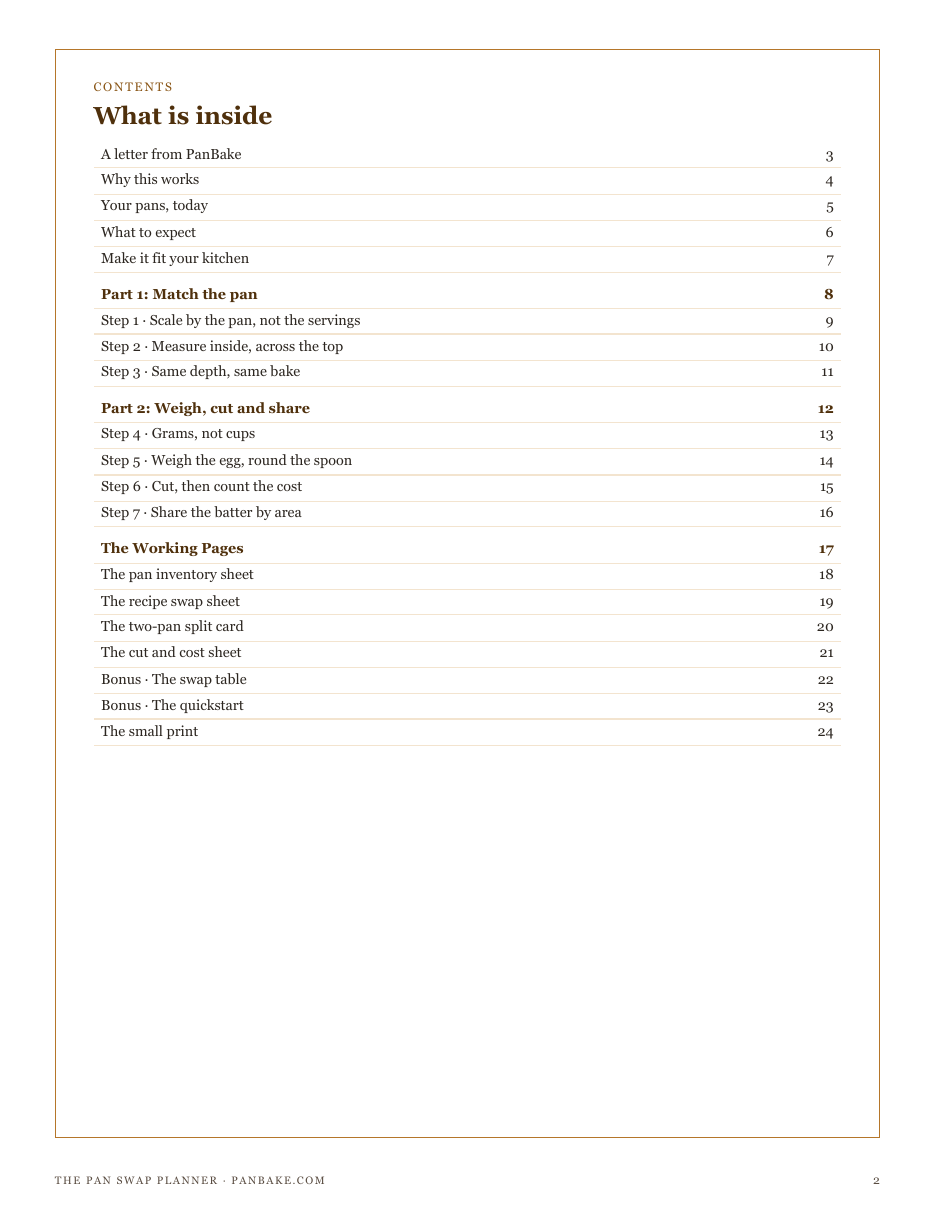
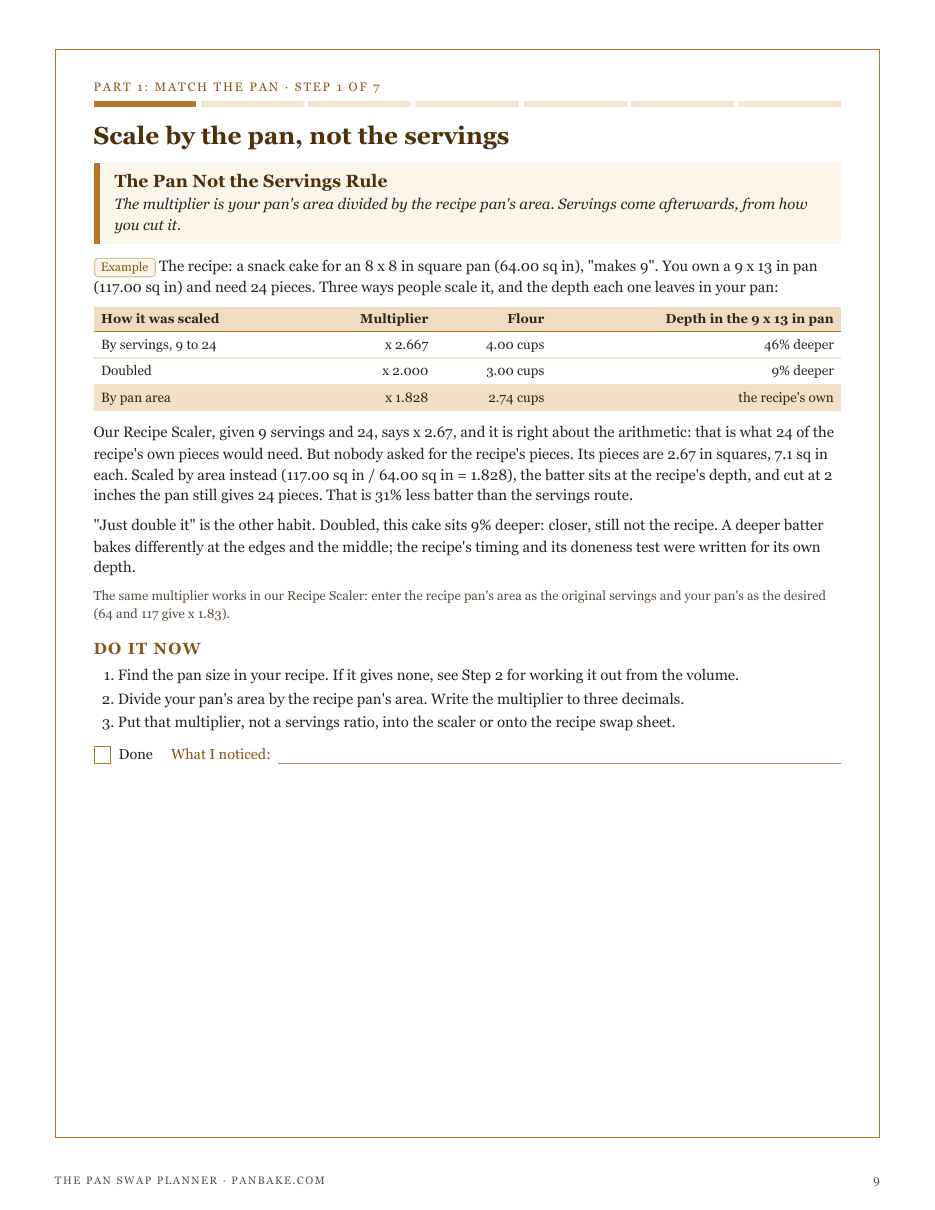
What is in it
- Step 1: the multiplier from the two pans' areas, against scaling by servings or doubling, with the depth each leaves in your pan
- Step 2: any pan measured inside across the top, rounds against squares, loaf pans, and Bundt or tube pans by water volume
- Step 3: the depth ratio worked before you mix, the rim check, and why the recipe's doneness test decides the time
- Step 4: every cup turned into grams once at USDA FoodData Central's cup weights, then multiplied
- Step 5: eggs poured by weight at 50 g a large egg, and spoon ingredients rounded to the eighth teaspoon
- Step 6: the pan cut at your piece size with none smaller, and the batch's cost divided by the pieces cut
- Step 7: one batter shared across two pans in proportion to their areas, weighed into each
- Four working pages: a pan inventory sheet, a recipe swap sheet, a two-pan split card and a cut and cost sheet
- A swap table of multipliers between eight common pans, and a quickstart that closes the score loop
- A personalised sheet: where your scaling factor lands in each common pan, your ingredients in grams, your conversion and your cost a piece
- ✓ 24 printable pages
- ✓ 10 sections, worksheets and templates
- ✓ A second PDF worked out from the numbers you enter
- ✓ No account needed, just an email address
- ✓ Instant download; link valid 7 days
Price includes any taxes. Sold by GrabURL, who handle checkout and support. The charge appears on your statement as GrabURL.
The plan picks up where the free Recipe Scalerleaves off. The scaler multiplies a recipe by servings; a recipe is written for a pan, and a serving is only a piece cut from it. The plan scales by the pan you own instead: each pan measured once, the multiplier from the two areas, the batter kept at the recipe’s depth, every cup turned into grams at USDA weights (the Unit Converter uses the same figures), eggs poured by weight, the pan cut and costed with the Meal Cost Calculator, and one batter shared across two pans by area. It gives no bake times or oven settings: when the pan changes, the recipe’s own doneness test decides. Every figure in it is an example for you to replace.